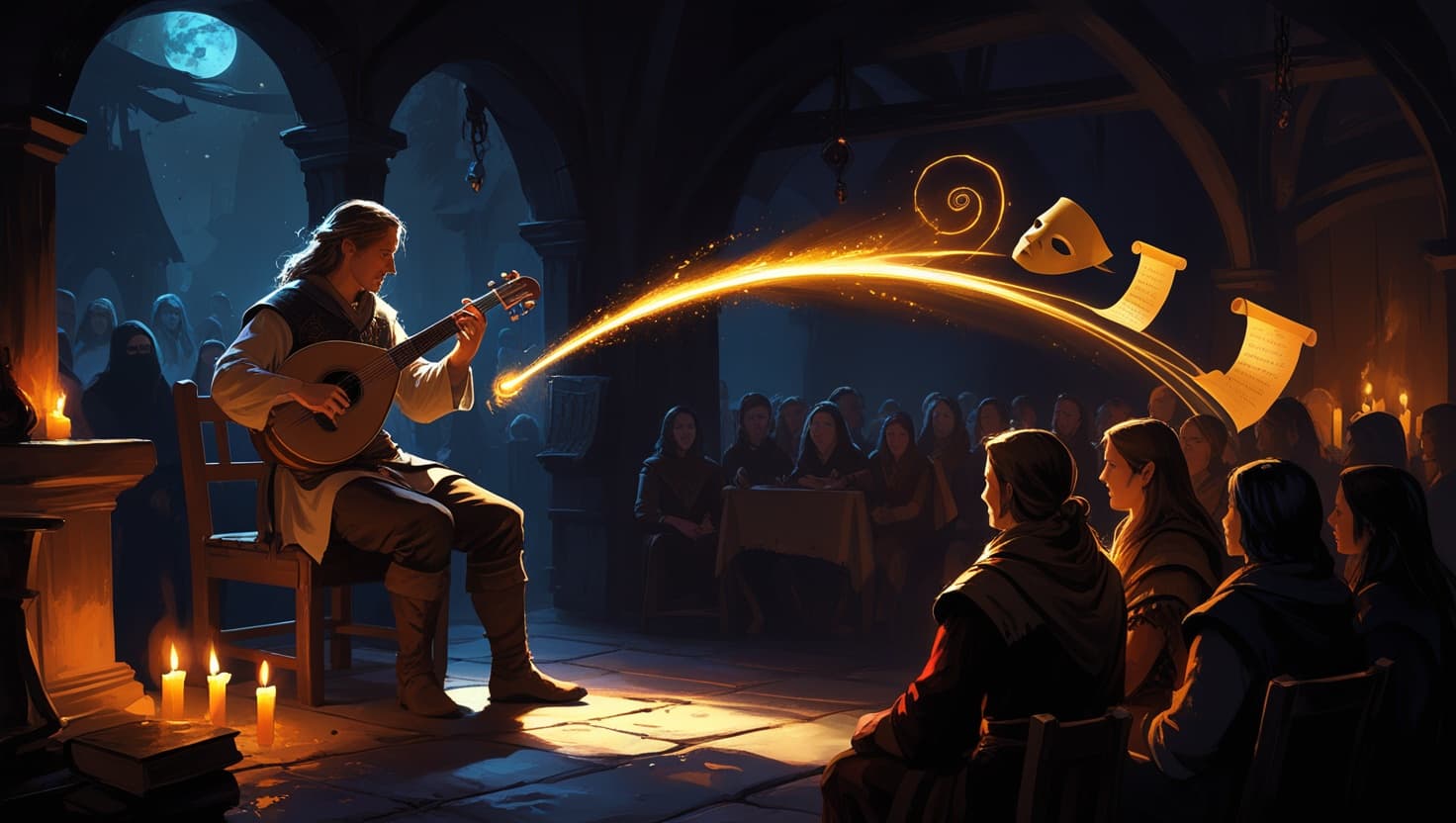
Best College of Lore Bard Build in 5e: The Ultimate Generalist for AI D&D
Every table has a player who wants to be the one with an answer for everything - the character who can pick the lock, read the ancient dialect, calm the guard captain down, and still land a decent hit when the fight starts. That character is the College of Lore Bard, and it's the subclass built to make "I've got this" true more often than any other class in the game.
Lore doesn't do one thing spectacularly. It does almost everything competently, and it comes with Cutting Words - a reaction that turns Bardic Inspiration into a defensive tool, not just a supportive one. The catch is that Cutting Words has a timing rule most tables fumble, and that's exactly the kind of small mechanical detail an AI Game Master handles better than a human running six other things at once.
If you want the broader case for Bards under an AI GM, check our Bard class guide. This guide goes deep on building the strongest College of Lore Bard specifically.
Why College of Lore Excels in AI Campaigns
Cutting Words' timing gets applied correctly
Cutting Words lets you spend a Bardic Inspiration die to subtract from an enemy's attack roll, ability check, or damage roll - but only if you use it before the GM announces whether that roll succeeded. Say it a beat too late, after the GM has already confirmed the hit, and the rules say the window has closed.
That's a genuinely easy rule to get wrong at a live table. A human GM juggling six players and a stat block rarely pauses mid-sentence to give you a formal "does anyone want to react before I say what happens" beat - the roll and the result tend to come out in the same breath. StoryRoll's AI GM structures combat narration as separate beats: the roll happens, then the outcome is confirmed, with room in between for a reaction. Cutting Words gets the window it's actually supposed to have, every time.
Eight-plus skills means the AI never locks you out
At 3rd level, Lore grants proficiency in three skills of your choice, on top of whatever your background and class already gave you - typically landing a Lore Bard at eight or more proficient skills before magic items or feats even enter the picture. No other class or subclass in 5e comes close.
An AI GM that's actually improvising - calling for Nature checks to read a storm, Investigation checks on a scene the Rogue already left, Persuasion when diplomacy is the only path forward - rewards exactly this kind of coverage. StoryRoll's AI calls for the check the situation demands rather than the check your party happens to be built around, and a Lore Bard is the character least likely to be the one standing there with nothing to roll.
Additional Magical Secrets patches gaps the AI actually creates
At 6th level, Magical Secrets lets you learn two spells from any class's list, as long as you can currently cast them. A Lore Bard picking up Cure Wounds because the party has no healer, or Shield because the AI's encounters have been hitting harder than expected, is filling a real, observed gap rather than a hypothetical one.
If you're not sure what to grab, ask what the last two or three sessions actually needed. A campaign that keeps throwing single hard-hitting enemies at you wants Absorb Elements or Shield. A campaign leaning on skill challenges and social scenes wants a utility spell like Comprehend Languages instead.
The Optimal Lore Bard Build
Ability scores
Charisma > Dexterity > Constitution > Wisdom > Intelligence > Strength
Charisma drives your spell save DC, your spell attack bonus, and every Bardic Inspiration die you hand out. Dexterity covers AC and initiative without the investment a heavy-armor build needs. Constitution keeps your concentration spells alive against a failed save.
Using point buy: 16 Cha, 14 Dex, 14 Con, 10 Wis, 8 Int, 8 Str before racial bonuses. If ability scores are still new territory, our ability score guide covers the basics before you build.
Best race picks
Half-Elf - a Charisma increase plus two skill proficiencies of your choice from any list, stacking directly onto a subclass that already wants as many skills as it can get. The default pick for a reason.
Variant Human - trades a second ability score bump for a feat at level 1. Skilled (three more skill or tool proficiencies) doubles down on the Lore identity; War Caster protects your concentration in melee range if you're leaning into the more aggressive Valor-adjacent playstyle within Lore.
Tiefling - a Charisma bump, fire resistance, and innate spellcasting that doesn't compete with your Bard slots, useful if your campaign runs hotter on damage than most.
Satyr - Charisma bonus, Magic Resistance against being charmed or put to sleep, and a strong Dexterity-friendly speed boost, at the cost of losing a feat most other options grant.
Skill and spell selection
Level 1 skills - Persuasion and Deception cover most social checks; Investigation or Perception covers the exploration side. Your background fills in a fourth.
Level 3 - Bonus Proficiencies (Lore). Pick three more skills you don't already have. Insight, Arcana, and History round out a Lore Bard who wants to be the party's answer to "does anyone know anything about this," but Athletics or Survival are worth considering if your table is light on physical skills.
Level 3 - Cutting Words. Automatic with the subclass. This is your primary defensive tool from here on - see the playstyle section below for how to actually use it well.
Level 6 - Additional Magical Secrets. Two spells from any list, as long as you can currently cast the level. See the FAQ above for how to pick.
Quick Build: The Know-It-All
- Race: Half-Elf
- Ability Scores: 16 Cha (+2 racial), 14 Dex, 14 Con (+1 racial), 10 Wis, 8 Int, 8 Str
- Skills at 3rd level: Insight, Arcana, History (plus starting Persuasion, Deception, Investigation)
- Cutting Words uses: Save one Bardic Inspiration die in reserve for every combat, even if it means using cantrips instead of a leveled spell
- Magical Secrets at 6th: Cure Wounds, Shield
- Playstyle: Know the answer, subtract the miss, patch the gap
Playstyle Tips for AI Campaigns
Hold a die in reserve, not just spend forward
It's tempting to hand out every Bardic Inspiration die the moment you see them, since that's the class's headline feature. A Lore Bard playing well holds at least one die back during any fight where a single hit could turn dangerous, so Cutting Words is available the moment it matters. Tell the AI what you're doing - "I'm holding a die back in case that ogre swings at our Cleric" - and let the narration confirm when the moment arrives.
Ask before the outcome, not after
Because StoryRoll narrates the roll and the result as separate beats, you get a real window to jump in with Cutting Words. Use it. If the AI describes an attack roll against an ally and pauses before confirming the hit, that's your cue - say you're using Cutting Words right then, not after you hear "it connects."
Lean into skills the AI actually calls for
A Lore Bard's eight-plus skills are only as good as how often you use them. Instead of waiting for the GM to ask for a roll, describe what your character is doing to investigate, persuade, or recall - "I want to see if I recognize this heraldry" - and let the AI call for the Arcana or History check that follows. StoryRoll rewards proactive description with the checks that match it.
Lore Bard pairs especially well with solo campaigns for the same reason Thief Rogue and Totem Warrior Barbarian do - broad skill coverage means fewer moments where you're locked out of a scene entirely. In solo campaigns, that versatility carries even more weight.
College of Lore vs Other Bard Colleges
Lore isn't the only strong Bard pick, and it's worth knowing what you're giving up.
Valor trades skill breadth for combat presence. You gain proficiency with medium armor, shields, and martial weapons, and your Combat Inspiration lets allies add the die to AC or damage instead of just attack rolls. Valor wins if your party wants you in the front line. Lore wins on being useful in every scene that isn't a fight.
Glamour is the strongest pure social manipulator, with Mantle of Inspiration granting temporary HP and free movement to allies and Enthralling Performance letting you charm a crowd outright. Glamour beats Lore in a campaign heavy on courts, negotiations, and fae-adjacent intrigue. Lore beats it everywhere else, since Glamour's biggest features are situational rather than always-on.
Whispers is the darkest option - Psychic Blades adds sneak-attack-style damage, and Words of Terror can frighten a target outside combat entirely. It's a strong pick for a Bard leaning into intimidation and interrogation over diplomacy, but it gives up the skill breadth that makes Lore the safest generalist choice.
For most groups, especially anyone who wants a character built to always have something useful to do, College of Lore remains the most consistently strong of the four.
Common Build Mistakes
Spending every Bardic Inspiration die immediately. Cutting Words only works if you have a die on hand when it matters. Handing all of them out the moment combat starts leaves you with nothing to subtract from the ogre's attack roll two turns later.
Using Cutting Words after the result is announced. The single most common way to lose this feature's value. The rules require you to act before the GM confirms the outcome - once you hear "it hits" or "the check succeeds," the window is closed.
Picking three redundant skills at 3rd level. Grabbing Persuasion, Deception, and Intimidation when you're already proficient in two of them wastes the point of Lore's bonus proficiencies. Fill gaps your build doesn't already cover.
Treating Additional Magical Secrets as a free spell slot upgrade. The two spells you gain should solve a real problem your party has - a missing healer, a missing counterspell, a missing area attack - not just be the flashiest option on the list.
Dumping Constitution. Concentration spells are a huge part of a Lore Bard's kit, and a failed Constitution save ends them early. Don't build a subclass this flexible and then lose your best spell to a stray arrow.
Frequently Asked Questions
Is College of Lore the best Bard subclass in 5e?
For most tables, yes. Lore grants proficiency in three extra skills at 3rd level, giving you the widest skill coverage of any class or subclass in the game, and Cutting Words turns Bardic Inspiration into a defensive tool that subtracts from an enemy's roll instead of only adding to an ally's. Valor is stronger in a party that needs you swinging a weapon, and Glamour edges it out for pure social manipulation, but Lore is the best all-rounder.
How does Cutting Words work, and when can you use it?
Cutting Words is a reaction available at 3rd level. When a creature you can see within 60 feet makes an attack roll, ability check, or damage roll, you can spend a Bardic Inspiration die and subtract it from that roll - but only before the outcome is announced. Wait until the GM says whether the attack hit or the check succeeded, and you've missed your window. That timing rule is the single most common way tables get Cutting Words wrong.
What race is best for a College of Lore Bard?
Half-Elf is the classic pick - a Charisma bump plus two free skill proficiencies stacks directly on top of a subclass already built around skill coverage. Variant Human works if you want a feat like Skilled or War Caster from level 1. Tiefling and Satyr both offer strong Charisma with useful defensive or mobility traits if you want more survivability than the pure skill-monkey build.
Does an AI Game Master handle Cutting Words timing correctly?
Yes. StoryRoll's AI GM announces the roll result as a separate beat from the roll itself, giving you the window Cutting Words needs before confirming whether an attack hits or a check succeeds. It also tracks how many Bardic Inspiration dice you have left and what die size they've scaled to, so you always know whether you can afford to spend one.
Is Lore Bard good for solo D&D campaigns?
Lore Bard solos unusually well. Jack of All Trades and eight-plus skill proficiencies mean there's rarely a check you're locked out of, Cutting Words gives you a defensive answer to a single hard-hitting enemy without needing a party member to protect, and Additional Magical Secrets lets you patch spell-list gaps - like grabbing a healing spell - that a full party would normally cover for you.
What should a Lore Bard pick for Additional Magical Secrets at level 6?
Pick spells outside the Bard list that fill a hole in your kit rather than duplicating what you already have. Healing Word or Cure Wounds if your party has no dedicated healer, Shield or Absorb Elements if you want more personal defense, or a strong utility spell like Fireball or Counterspell if your DPR or spellcasting shutdown is thin. Since the spells only need to be a level you can currently cast, revisit this pick's value as you level and your gaps change.
College of Lore is the Bard subclass built for coverage, and Cutting Words specifically turns your Bardic Inspiration dice into something you can use to protect the party, not just boost it. The catch is that Cutting Words lives or dies on timing - a window that closes the moment a GM confirms the outcome - which is exactly the kind of pacing detail a human table blows through and an AI GM holds open on purpose.
Build around Charisma with a broad skill spread, hold at least one Bardic Inspiration die in reserve every fight, and use Additional Magical Secrets to patch whatever gap your last few sessions actually revealed.
Build your Lore Bard on StoryRoll and see how far "I've got this" actually gets you.
If you want to see how other classes hold up under the same build-optimization lens, Totem Warrior Barbarian and Thief Rogue follow the same pattern of picking the strongest subclass and building around it.
Try These Free Tools
Gear up your Lore Bard build with these free resources:
- Spell Slot Tracker: keep track of leveled spell slots alongside your Bardic Inspiration dice.
- Skill Check Reference: a quick lookup for every skill your eight-plus proficiencies can cover.
- Dice Roller: roll Bardic Inspiration dice, spell attacks, and saving throws.
Written by StoryRoll
Founder of StoryRoll. Building AI-powered tabletop RPGs.
Related Posts
Best Circle of the Moon Druid Build in 5e: The Second Health Bar
Circle of the Moon is the combat Druid subclass, built around bonus-action Wild Shape and a beast form that soaks damage before your real HP is ever at risk.
Best Oath of Devotion Paladin Build in 5e: The Classic Holy Knight for AI D&D
Oath of Devotion is the clearest, most classic Paladin build in 5e. Here's the optimal ability scores, race picks, and how Sacred Weapon timing shines under an AI Game Master.
Best Totem Warrior Barbarian Build in 5e: The Ultimate Survivor for AI D&D
Path of the Totem Warrior is the most survivable Barbarian subclass in 5e. Here's the optimal build, totem picks, and why it shines under an AI Game Master.