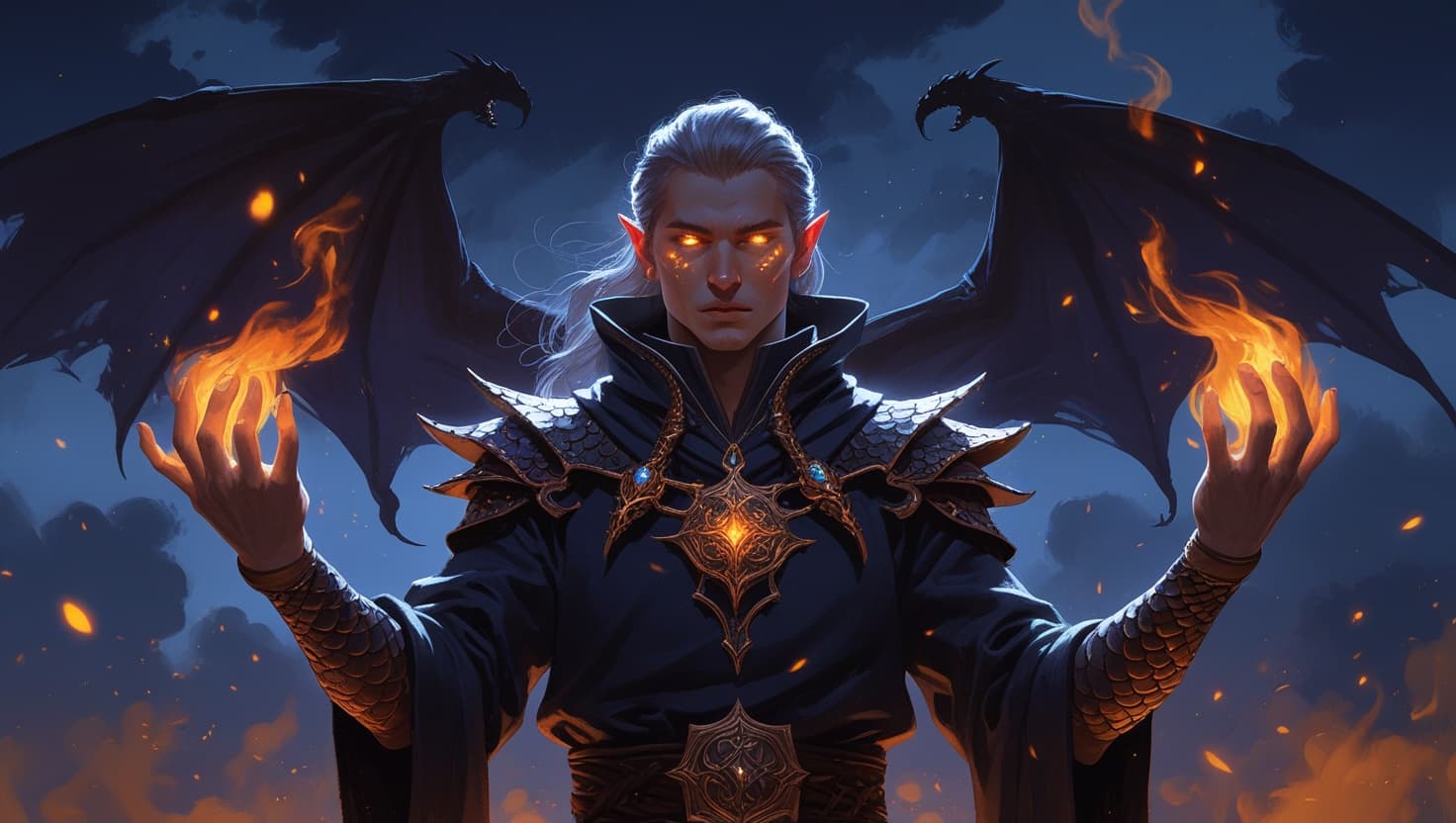
Best Draconic Bloodline Sorcerer Build in 5e: The Caster Who Doesn't Flinch
Sorcerers have a reputation for being glass cannons - huge magical potential wrapped in a body that goes down to one bad round. Draconic Bloodline exists to break that reputation. It's the only Sorcerous Origin built around a simple promise: you're still a full caster, but you're also harder to kill than most people expect a caster to be.
The subclass does this with bonus hit points that stack every level, natural armor that works whether or not you're wearing any, and - once you've leveled far enough - genuine resistance to the damage type tied to your draconic ancestry. None of it requires tracking anything exotic. It requires someone remembering it's there, which is exactly where a human table's attention gets pulled elsewhere and an AI Game Master doesn't.
If you want the broader picture on playing a Sorcerer with an AI GM, start with our Sorcerer class guide. This one goes deep on building the strongest Draconic Bloodline specifically.
Why Draconic Bloodline Excels in AI Campaigns
Bonus HP and natural armor get applied without a reminder
Draconic Resilience, gained at 1st level, grants an extra hit point immediately and one more every time you level up after that, plus a base AC of 13 plus your Dexterity modifier when you aren't wearing armor. Both numbers are easy to forget mid-session - the bonus HP especially, since it isn't listed on a standard character sheet template the way class HP dice are.
A human GM tracking several characters' HP totals, each with its own subclass adjustments, is the likeliest place this quietly gets missed. StoryRoll calculates your Draconic Resilience bonus into your HP total and AC from the moment you pick the subclass, so the numbers are already correct every time damage lands - no separate note to remember, no recalculating after a level-up.
Elemental Affinity's resistance option actually gets offered
At 6th level, Elemental Affinity lets you spend a Sorcery Point to gain resistance to your bloodline's damage type for a full hour, on top of the bonus damage it already adds to your own spells. That resistance is a proactive choice you have to remember to make before a fight starts getting dangerous, not something that triggers automatically.
An AI GM that tracks your Sorcery Points and your bloodline's damage type can surface that option at the right moment - when a fire-breathing enemy shows up, or when you're deciding how to spend your last few points before a fight. That's friction most players lose entirely at a busy table, and worth asking the AI about before you commit to a round.
Your damage type becomes a real narrative thread, not a stat line
Which element your ancestry channels - fire, cold, lightning, poison, or acid - isn't just a box you check for Elemental Affinity's bonus damage. StoryRoll treats it as a standing detail the world can react to: scales that shimmer faintly when you're channeling, a telltale scent of ozone before you cast, a dragon cultist who recognizes exactly what you are the moment they see it. Tell the AI what your magic looks like when it manifests and it becomes material the story returns to, not a line from character creation nobody mentions again.
Describe what your draconic features actually look like beyond the mechanics - scale color, eye shape, the faint smell or shimmer when you cast. That detail gives the AI something concrete to narrate back every time your bloodline shows itself, instead of a generic "you feel powerful" description.
The Optimal Draconic Bloodline Build
Ability scores
Charisma > Constitution > Dexterity > Wisdom > Strength > Intelligence
Charisma drives your spell save DC, spell attack bonus, and the bonus damage Elemental Affinity adds to every qualifying spell. Constitution stacks with your already-boosted HP total from Draconic Resilience and protects your concentration saves. Dexterity feeds your natural armor's AC directly, since Draconic Resilience's 13 + Dex formula rewards every point you put there.
Using point buy: 15 Cha, 14 Con, 13 Dex, 10 Wis, 8 Str, 8 Int before racial bonuses. New to ability scores? Our ability score guide covers the basics before you build.
Best damage type picks
Fire - The deepest spell list in the game pairs with this choice: Fire Bolt, Burning Hands, Scorching Ray, Fireball, and Wall of Fire all qualify for Elemental Affinity's bonus damage. If you want Elemental Affinity to matter on nearly every damage spell you cast, Fire is the safest pick.
Cold - A close second, with Ray of Frost, Cone of Cold, and Ice Storm covering both single-target and area damage at different tiers. Cold also resists some of the same monster types Fire does, making the two roughly comparable in practical value.
Lightning - A workable third option with Witch Bolt and Lightning Bolt as its anchors, though the list thins out faster than Fire or Cold's.
Avoid Poison and Acid unless your table's monster roster specifically rewards it - both have thin spell selections, and a meaningful portion of common enemies resist or are outright immune to poison damage, undercutting Elemental Affinity's entire purpose.
Best race picks
Dragonborn - The obvious thematic match: a breath weapon you can flavor to match your bloodline's element, and damage resistance that stacks with Elemental Affinity once it comes online. The Strength bonus goes largely unused, but it costs nothing to carry.
Half-Elf - The strongest mechanical generalist: a flat Charisma bonus plus two free +1s to split between Constitution and Dexterity, two bonus skill proficiencies of your choice, and resistance to being charmed. A safe, powerful pick if Dragonborn's flavor doesn't fit your character concept.
Tiefling - A strong thematic and mechanical fit specifically for a Fire-type bloodline: innate fire resistance stacks on top of Elemental Affinity's later resistance option, and the Charisma bonus goes straight into your primary stat.
Quick Build: The Unbroken Bloodline
- Race: Half-Elf (or Dragonborn for stronger flavor fit)
- Ability Scores: 15 Cha (+2 racial), 14 Con, 13 Dex (+1 racial), 10 Wis, 8 Str, 8 Int
- Damage type: Fire
- Key Spells: Fire Bolt or Chromatic Orb (cantrip/early damage), Shield, Scorching Ray, Fireball once available
- Skills: Persuasion, Arcana, plus Half-Elf's two free picks
- Playstyle: Stand closer to danger than most casters would dare, and let Draconic Resilience's HP and AC absorb what a standard caster couldn't
Playstyle Tips for AI Campaigns
Lean into melee range more than other Sorcerers would
Draconic Resilience's bonus HP and natural armor exist to let you take hits a typical Sorcerer can't afford to. Tell the AI you're holding a closer position than usual - near the front line, inside a melee scrum - and let the extra durability actually do something instead of playing as cautiously as a Wizard would.
Ask about resistance before you need it
Elemental Affinity's hour-long resistance option is easy to forget exists until you're already mid-fight and wishing you'd spent the point ten minutes earlier. Build the habit: when a scene starts escalating, ask the AI whether spending a Sorcery Point on resistance now makes sense, rather than waiting until the damage has already landed.
Pick spells that actually use your damage type
Elemental Affinity's bonus damage only applies to spells matching your bloodline's element. A Fire-bloodline Sorcerer who fills their spell list with Lightning Bolt and Ray of Frost is leaving a real damage bonus on the table every single cast. Build your spell list around your chosen element first, and pick up off-type spells only for situations where resistance on the enemy side makes your main element useless.
Draconic Bloodline pairs especially well with solo campaigns for the same reason Totem Warrior Barbarian does: bonus HP and a layer of resistance mean you can survive fights a standard caster would need a party healer to get through.
Draconic Bloodline vs Other Sorcerous Origins
Draconic Bloodline isn't the only strong Sorcerer pick, and it's worth knowing what you're trading away.
Wild Magic trades Draconic Bloodline's steadiness for narrative unpredictability. Tides of Chaos gives you advantage on a roll once per rest at the cost of risking a Wild Magic Surge on your next cast, and Bend Luck lets you spend Sorcery Points to nudge any roll later on. Wild Magic wins on story variance and moment-to-moment surprise. Draconic Bloodline wins on simply not dying as often.
Divine Soul (available in some campaigns) trades Elemental Affinity's damage focus for the Cleric spell list alongside your own - strong if your table wants a support-capable Sorcerer, but it doesn't match Draconic Bloodline's HP and AC advantage, and splits your spell choices across two lists instead of specializing.
Clockwork Soul (where available) protects allies and counters magical effects rather than protecting yourself - a genuinely different niche than Draconic Bloodline's personal survivability.
For most tables, especially solo play or any campaign where a Sorcerer needs to hold a position without a dedicated tank nearby, Draconic Bloodline remains the subclass that makes "fragile spellcaster" the least accurate description of your character.
Common Build Mistakes
Picking a damage type without checking the spell list behind it. Elemental Affinity only matters on spells that match your element. Fire and Cold both have deep spell support; Acid and Poison don't. Choose the element first by checking what spells actually exist for it, not by which dragon color sounds coolest.
Forgetting the bonus HP exists after a level-up. Draconic Resilience's extra hit point per level is easy to lose track of on a sheet that doesn't call it out separately from your class HP die. Let an AI GM that tracks it automatically handle the math instead.
Treating natural armor as a reason to ignore Dexterity. Draconic Resilience's AC formula is 13 plus your Dexterity modifier - it rewards that investment, it doesn't replace the need for it.
Never spending the Sorcery Point on resistance. Elemental Affinity's hour-long resistance costs a point you could save for Metamagic instead, which makes it tempting to skip. Against an enemy using your bloodline's damage type, that point is usually the better spend.
Ignoring the roleplay layer entirely. A dragon somewhere in your family line is a genuine hook, not just flavor text. Players who never describe what their ancestry looks or feels like miss scenes an AI GM is ready to build around.
Frequently Asked Questions
Is Draconic Bloodline the best Sorcerer subclass in 5e?
For survivability, yes. Draconic Bloodline gives you bonus hit points at every level, natural armor that works even without armor proficiency, and eventually resistance to your bloodline's damage type - durability no other Sorcerous Origin matches. Wild Magic trades that steadiness for narrative chaos and a few strong utility features. If you want a Sorcerer who can stand in a fight without a Wizard's fragility, Draconic Bloodline is the pick.
Which draconic ancestry damage type should I pick?
Fire and Cold are the strongest picks because the Sorcerer spell list has the deepest bench of fire and cold spells to pair with Elemental Affinity's bonus damage. Lightning and Poison both have thinner spell selections, and Poison in particular struggles against the many creatures with poison resistance or immunity. Acid is the weakest choice for the same reason - a short spell list limits how often Elemental Affinity actually comes up.
What race is best for a Draconic Bloodline Sorcerer?
Dragonborn is the obvious thematic fit - a breath weapon and damage resistance that can match your bloodline's element, plus a Strength bump you won't use but costs nothing to ignore. Half-Elf is the stronger mechanical pick for most tables: a flat Charisma bonus, two free skill proficiencies, and resistance to being charmed. Tiefling works well if your bloodline's damage type is fire, since its own resistance stacks thematically even though the mechanical benefit is situational.
How does an AI Game Master track natural armor and damage resistance?
StoryRoll tracks your Draconic Resilience AC baseline, your current hit point total including the bonus HP from the subclass, and which damage type your bloodline resists once Elemental Affinity comes online - applying all three automatically whenever a hit or a save comes up. Tell the AI your ancestry's damage type once at character creation and it carries that forward every session without you needing to remind it.
Is Draconic Bloodline good for solo D&D campaigns?
It's one of the strongest solo picks among full casters. Bonus HP at every level and natural armor mean you can take a hit that would drop a standard Sorcerer, and resistance to your bloodline's damage type removes an entire category of threat from the table once it comes online. A solo Draconic Bloodline Sorcerer survives fights that would otherwise force a retreat.
Does Draconic Bloodline get any offensive features, or is it purely defensive?
Elemental Affinity, gained at 6th level, adds your Charisma modifier as bonus damage to any spell you cast that deals damage of your bloodline's type, and lets you spend a Sorcery Point to gain resistance to that same damage type for an hour. It's a real offensive boost on top of the subclass's defensive identity, not just a flavor feature - which is why picking a damage type with a deep spell list matters so much.
Draconic Bloodline is the Sorcerous Origin built for staying alive, and it only delivers on that promise if someone is actually tracking the bonus HP, the natural armor, and the resistance window Elemental Affinity opens up. That's bookkeeping a busy human table drops constantly and an AI Game Master never does.
Build around Charisma and Constitution, pick a damage type with real spell support behind it, and stand closer to the fight than a typical Sorcerer would dare.
Create your Draconic Bloodline Sorcerer on StoryRoll and find out how far "fragile spellcaster" stops being true.
If you want to see how other classes hold up under the same build-optimization lens, Circle of the Moon Druid and Totem Warrior Barbarian follow the same pattern of picking the strongest subclass and building around it.
Try These Free Tools
Gear up your Draconic Bloodline build with these free resources:
- Ability Score Calculator: maximize Charisma and Constitution alongside the Dexterity your natural armor depends on.
- Spell Slot Tracker: track spell slots and Sorcery Points side by side for Elemental Affinity's resistance spend.
- Dice Roller: roll spell attacks, saves, and damage without breaking the scene.
Written by StoryRoll
Founder of StoryRoll. Building AI-powered tabletop RPGs.
Related Posts
Best Way of Shadow Monk Build in 5e: The Infiltrator AI Campaigns Reward
Way of Shadow trades straightforward Monk power for a stealth-and-teleport toolkit that only works if someone tracks dim light and darkness correctly. Here's the build.
Best Circle of the Moon Druid Build in 5e: The Second Health Bar
Circle of the Moon is the combat Druid subclass, built around bonus-action Wild Shape and a beast form that soaks damage before your real HP is ever at risk.
Best Oath of Devotion Paladin Build in 5e: The Classic Holy Knight for AI D&D
Oath of Devotion is the clearest, most classic Paladin build in 5e. Here's the optimal ability scores, race picks, and how Sacred Weapon timing shines under an AI Game Master.