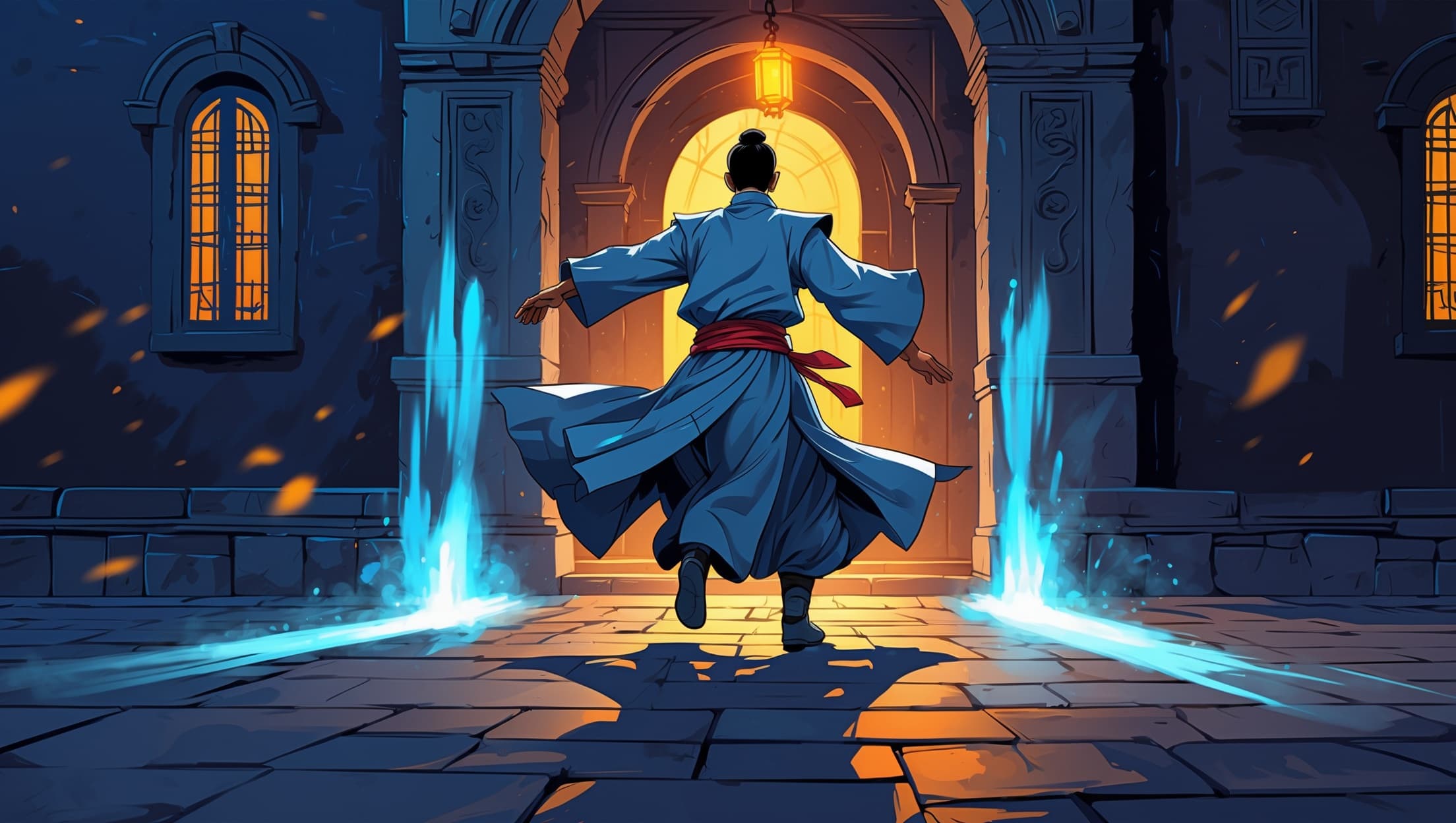
Best Way of Shadow Monk Build in 5e: The Infiltrator AI Campaigns Reward
Way of the Open Hand gets you through most fights. Way of Shadow gets you out of fights you never needed to have in the first place - and into the one you actually picked, on your own terms, with advantage on the first strike.
That's the trade. Shadow Arts and Shadow Step spend the same tight Ki budget every Monk works with, but instead of buying extra control in combat, they buy options outside it: become invisible in the dark, cross a room nobody sees you cross, silence the one guard who'd raise the alarm. None of it means anything if whoever's running the scene isn't actually tracking which parts of the room are lit, dim, or pitch black - and that bookkeeping is exactly where this subclass gets shortchanged at a traditional table and overperforms with an AI Game Master running it.
If you want the full class picture first, our Monk guide for AI D&D covers all three Monastic Traditions. This one goes deep on building the strongest Way of Shadow specifically.
Why Way of Shadow Excels in AI Campaigns
Dim light and darkness get tracked, not eyeballed
Shadow Step only works between two spaces that are both in dim light or darkness, and Cloak of Shadows only works while you're standing in one. At a human table, that usually means someone squinting at a battle map trying to remember whether the far corner is still lit after the torch got knocked over two rounds ago. An AI GM keeps the lighting state of a scene current and checks it against what Shadow Step and Cloak of Shadows actually require before either one resolves, instead of taking your word for it or guessing.
That precision cuts both ways, which is the point. You can't bluff a teleport through a space that's secretly too bright, but you also don't lose a legitimate one to a GM who forgot the lamp went out.
Ki spent on utility is tracked as precisely as Ki spent on offense
Shadow Arts lets you spend 2 Ki Points to cast Darkness, Darkvision, Pass Without Trace, or Silence, on top of everything else pulling from the same pool. Every human-GM table has, at some point, let a Monk "round down" their Ki spend because nobody wanted to stop and do the arithmetic mid-scene. StoryRoll's character sheet keeps a running total instead, applying Shadow Arts' cost the instant you cast and resetting the pool correctly on a short rest, so spending 2 Ki on Pass Without Trace before a heist actually means less left for Shadow Step later in the same scene.
Stealth checks mean something when the GM plays guards honestly
Way of Shadow is built around sneaking past or ambushing enemies, and that only matters if the enemies are actually trying to notice you. A tired human GM running six NPCs at once often waves a party past a guard who should have rolled Perception. An AI GM runs passive Perception and active searches consistently - see our passive perception guide for how that works - which means Pass Without Trace and a well-timed Silence spell solve a real problem instead of a formality nobody was going to check anyway.
Before you commit to a stealth approach, ask the AI what the lighting and guard positions actually look like, or just pay close attention to how the scene gets described. Shadow Step and Cloak of Shadows are only as good as your read on where the dark actually is.
The Optimal Way of Shadow Build
Ability scores
Dexterity > Wisdom > Constitution > Charisma > Strength > Intelligence
Dexterity drives your attack rolls, AC through Unarmored Defense, and most of the skill checks a stealth build leans on - Stealth and Acrobatics above all. Wisdom sets your Ki save DC for Stunning Strike and adds to Unarmored Defense alongside Dexterity. Constitution protects your (still modest) HP pool, since a Monk who gets caught without an escape route needs to survive the fight that follows.
Using point buy: 16 Dex, 14 Wis, 13 Con, 10 Cha, 8 Str, 8 Int before racial bonuses. If you're still getting comfortable with the basics, our ability score guide walks through point buy and the standard array before you build.
Best race picks
Wood Elf - A Dexterity bonus feeds the build's primary stat directly, Mask of the Wild lets you hide in light fog or foliage without full cover, and extra base speed stacks with Unarmored Movement. Check our Elf race guide for the full breakdown.
Halfling - Lucky re-rolls a natural 1 on any attack, check, or save, quietly protecting your Dexterity saves and Stunning Strike DC math over a long campaign. See our Halfling race guide for details.
Tiefling - Darkvision out of the gate means you can see what you're teleporting into. Our Tiefling race guide covers the subraces worth comparing.
Variant Human - Take Mobile for a speed boost plus no opportunity attacks after a melee hit, extending the escape-and-reposition game this subclass already wants to play.
Feature progression
3rd level - Shadow Arts. Spend 2 Ki Points to cast Darkness, Darkvision, Pass Without Trace, or Silence without needing their usual components, and learn Minor Illusion if you don't already know it. Pass Without Trace is the standout - a +10 bonus to a whole group's Stealth checks turns "sneak past the guards" from a coin flip into a near-certainty.
6th level - Shadow Step. As a bonus action while in dim light or darkness, teleport up to 60 feet to an unoccupied space you can see that's also in dim light or darkness, then gain advantage on the first melee attack you make before the end of the turn. This is the subclass's entire combat identity in one feature: close distance, open with advantage, and if the fight goes badly, you have the same tool to leave.
11th level - Cloak of Shadows. Use your action to become invisible while standing in dim light or darkness, lasting until you attack, cast a spell, or step into bright light. Pair it with Shadow Step and you can vanish, reposition, and strike from a space the enemy never saw you occupy.
17th level - Opportunist. When a creature within 5 feet of you is hit by an attack from someone other than you, use your reaction to make a melee attack against that same creature. At this level you're rarely alone in a fight, and Opportunist turns every ally's hit into a potential second attack of your own.
Quick Build: The Vanishing Point
- Race: Wood Elf
- Ability Scores: 16 Dex (+2 racial), 14 Wis, 13 Con, 10 Cha, 8 Str, 8 Int
- Tradition Features: Shadow Arts (3rd), Shadow Step (6th), Cloak of Shadows (11th), Opportunist (17th)
- Skills: Stealth, Acrobatics, Perception, Insight
- Key Spell to Save Ki For: Pass Without Trace, before any scene you'd rather not fight through
- Playstyle: Pick the fight that happens in the dark, on your terms, or don't have the fight at all
Playstyle Tips for AI Campaigns
Scout the lighting before you commit to a plan
Shadow Step and Cloak of Shadows both live or die on whether dim light or darkness is actually available where you need it. Ask the AI what the room looks like, or read the scene closely for cues - torchlight, moonlight, a flickering brazier - before you bank an entire approach on a teleport that needs darkness you haven't confirmed exists yet.
Spend Pass Without Trace on the whole party, not just yourself
It's tempting to hoard Ki for your own Shadow Step, but Pass Without Trace boosts everyone's Stealth check, and getting a whole party past a guarded choke point is often worth more than one more teleport later. Say it out loud - "I cast Pass Without Trace before we approach" - and let the AI apply the bonus to every check that follows.
Use Shadow Step to disengage, not just to attack
The advantage on your next melee hit gets the attention, but the teleport itself is a free escape from a bad position. If a fight turns against you, Shadow Step out instead of eating another round of attacks.
Way of Shadow pairs naturally with a solo campaign built around infiltration - no party to accidentally light up a dark room while you're trying to stay hidden in it. If stealth tactics in general feel unreliable at your table, our hide action breakdown covers the rule most games get wrong before you even get to this subclass's extra tools.
Way of Shadow vs Other Monk Traditions
Way of the Open Hand trades stealth utility for straightforward control. Open Hand Technique triggers off Flurry of Blows with no Ki cost and no save on your end - prone, shove, or deny reactions, every time you connect. It's the stronger pick if your table fights more than it sneaks.
Way of Mercy spends the identical Ki pool on Hand of Harm and Hand of Healing instead of Shadow Arts, making you a striker and healer in one kit rather than an infiltrator.
Warrior of Shadow is the 2024 revision's version of this subclass, and multiple sources describe it as a substantial overhaul of how darkness and teleportation interact with the Monk's own vision - worth checking if your table runs the newer rules. The core build logic here still applies either way.
For stealth-first, solo-friendly, or infiltration-heavy campaigns, Way of Shadow remains the Monk's clearest identity of the three.
Common Build Mistakes
Treating Shadow Step as purely an attack button. The teleport itself - free repositioning to any dim or dark space you can see - is valuable even on turns where you don't want to fight. Using it only when attacking wastes half of what the feature does.
Forgetting Pass Without Trace needs to go on before the Stealth check, not after. It's a Ki-fueled spell with a duration, not a reactive save. Cast it before the party approaches.
Dumping Constitution too far. A Monk already has a modest HP pool, and Way of Shadow's whole plan depends on surviving the moments stealth fails.
Picking fights in bright light out of habit. The entire subclass is built around darkness. A Shadow Monk who defaults to charging into a well-lit room is playing against their own kit.
Frequently Asked Questions
Is Way of Shadow the best Monk subclass in 5e?
It depends what you want from the class. Way of the Open Hand hits harder and controls fights more reliably, but Way of Shadow is the strongest pick for stealth, infiltration, and mobility - Shadow Step lets you teleport between patches of dim light or darkness and strike with advantage the instant you arrive, which no other Monk tradition offers.
What race is best for a Way of Shadow Monk?
Wood Elf is the classic pick. A Dexterity bonus, Mask of the Wild lets you hide in light natural obscurement, and a free movement speed bump all reinforce the same stealth-and-mobility identity. Halfling adds Lucky to protect your saves, and Tiefling's innate darkvision pairs well with a build that wants to be in darkness constantly.
How does an AI Game Master track Shadow Step and dim light?
StoryRoll tracks which spaces in a scene are lit, dim, or dark, and checks that against Shadow Step's requirements before letting the teleport resolve, instead of leaving it to a player's memory of where the torchlight was three rounds ago. It also tracks your Ki Point total as you spend it on Shadow Arts, so Darkness, Pass Without Trace, and Silence all draw from the correct pool automatically.
Is Way of Shadow good for solo D&D campaigns?
Yes, and arguably better solo than in a full party. Shadow Step and Cloak of Shadows let a solo Monk avoid fights entirely or pick exactly which one enemy to engage, which matters more when there's no party to absorb a bad pull. Pass Without Trace from Shadow Arts also makes solo scouting and infiltration genuinely reliable instead of a single high-risk Stealth check.
What's the difference between Way of Shadow and Way of Mercy?
Way of Shadow spends Ki on stealth, mobility, and utility spells - Darkness, Pass Without Trace, Silence, Minor Illusion - built around avoiding and ambushing fights. Way of Mercy spends the same Ki pool on direct damage and healing, built around staying in a fight as both striker and medic. They solve different problems with the same resource.
Way of Shadow is the Monk tradition built for players who'd rather pick their fights than take whatever the dungeon hands them, and Shadow Step specifically turns darkness into a tactical resource instead of just an obstacle to see through. All of it depends on someone actually tracking which spaces are lit, dim, or dark at any given moment - the exact bookkeeping a busy human table loses and an AI GM never drops.
Build around Dexterity and Wisdom, save Ki for Pass Without Trace before the moments that matter, and stop treating every fight as something you have to win head-on.
Build your Way of Shadow Monk on StoryRoll and see how far a teleport into the dark actually gets you.
If you want to see the same build-optimization approach applied to other classes, Totem Warrior Barbarian and Beast Master Ranger follow the same pattern of picking the strongest subclass and building around it.
Try These Free Tools
Gear up your Way of Shadow build with these free resources:
- Ability Score Calculator: balance Dexterity and Wisdom with point buy or standard array.
- Dice Roller: roll Stealth checks, Martial Arts dice, and Ki saves in seconds.
- Initiative Tracker: keep track of who acts before your Shadow Step opens the fight.
Written by StoryRoll
Founder of StoryRoll. Building AI-powered tabletop RPGs.
Related Posts
Best Circle of the Moon Druid Build in 5e: The Second Health Bar
Circle of the Moon is the combat Druid subclass, built around bonus-action Wild Shape and a beast form that soaks damage before your real HP is ever at risk.
Best Oath of Devotion Paladin Build in 5e: The Classic Holy Knight for AI D&D
Oath of Devotion is the clearest, most classic Paladin build in 5e. Here's the optimal ability scores, race picks, and how Sacred Weapon timing shines under an AI Game Master.
Best College of Lore Bard Build in 5e: The Ultimate Generalist for AI D&D
College of Lore is the most flexible Bard subclass in 5e. Here's the optimal build, skill picks, and why Cutting Words shines under an AI Game Master.