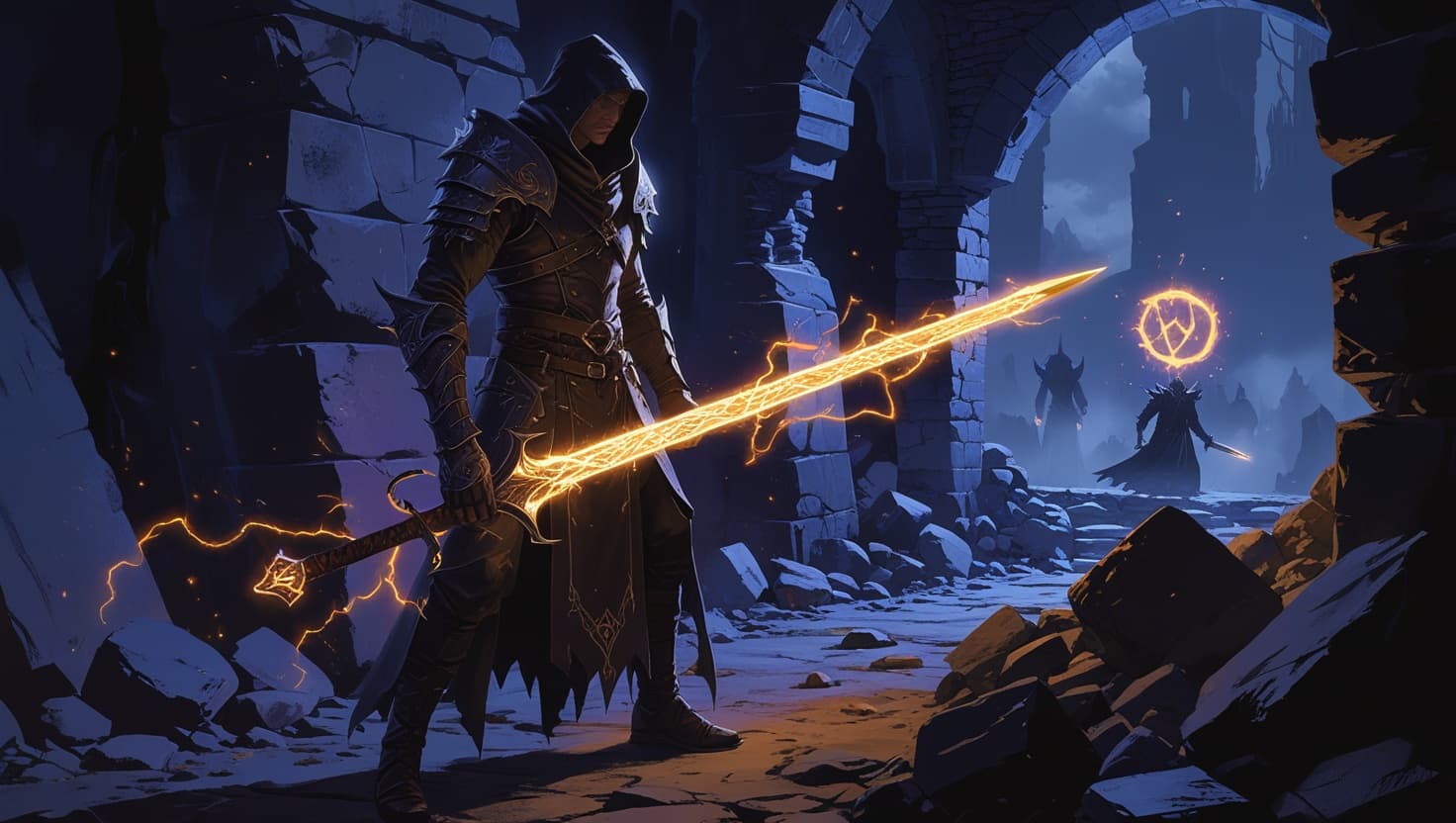
Best Hexblade Warlock Build in 5e: The Melee Caster AI Campaigns Finally Track Right
Every other melee class in D&D gets to swing a weapon off the stat they already built around. Warlocks don't - until Hexblade hands you a loophole: use Charisma for the attack and the damage, on any one-handed weapon you choose.
That loophole is the whole subclass. Hex Warrior turns a Warlock into a weapon-user without touching Strength or Dexterity, and Hexblade's Curse stacks a proficiency-bonus damage bump and an expanded crit range on top of it - but only against one specific creature, for exactly one minute, until you either let it lapse or burn a spell slot to recast it early. That's precise bookkeeping most human tables eyeball instead of track, and it's exactly the kind of detail an AI Game Master doesn't drop three rounds into a fight.
If you want the full class picture first, our Warlock guide for AI D&D covers patrons, pact boons, and invocations more broadly. This one goes deep on building the strongest Hexblade specifically.
Why Hexblade Excels in AI Campaigns
Hexblade's Curse applies to exactly one target, not the whole fight
Hexblade's Curse is a bonus action that marks one creature within 30 feet for one minute: weapon attacks against it get your proficiency bonus added to the damage, and your crit range against it expands to 19-20. Nothing about any of that touches a second enemy, even one standing right next to the cursed one. At a human table, that distinction gets lost fast - someone remembers "I'm cursed up" and forgets which goblin the curse is actually on. An AI GM keeps the cursed creature's identity and the curse's remaining duration as a fact about the encounter, and only applies the bonus damage and crit range when you're actually hitting that specific target.
Pact Magic recovers on a short rest, same as every other Warlock
Like all Warlocks, a Hexblade's spell slots come back on a short rest instead of a long one - which matters more here because Hex and Armor of Agathys are both worth recasting between fights rather than hoarding. Our short rest vs. long rest breakdown covers why that distinction trips up tables that default to "everyone recovers the same way." StoryRoll tracks your Pact Magic recovery separately from every long-rest caster at the table, and reminds you when a short rest is actually on offer.
Hex Warrior's weapon choice stays locked in, not quietly swapped
Hex Warrior only lets your Charisma modifier substitute for Strength or Dexterity on the one weapon you chose when you picked the feature (or the Pact Weapon you later summon through Pact of the Blade). Switch weapons mid-fight at a forgetful table and the Charisma-swap sometimes follows along anyway, unnoticed. An AI GM tracks which exact weapon your build applies Hex Warrior to, so picking up a stray greataxe off the ground doesn't accidentally inherit a bonus it was never meant to get.
The Optimal Hexblade Build
Ability scores
Charisma > Constitution > Dexterity > Wisdom > Strength/Intelligence
Charisma drives your spell save DC, your Hex Warrior attack and damage rolls, and your Hexblade's Curse healing on a kill. Constitution keeps you alive while standing in melee with a d8 hit die and no Extra Attack until you fix that with an invocation. Dexterity past a 14 mostly isn't worth it once you're in medium armor, since Hex Warrior already lets Charisma carry your weapon math.
Using point buy: 16 Cha, 14 Con, 14 Dex, 10 Wis, 8 Str, 8 Int before racial bonuses. If you're still deciding how to spend points, our ability score guide covers point buy and the standard array.
Best race picks
Variant Human - A free feat at 1st level means you can take War Caster (to protect Hex's concentration in melee) or Great Weapon Master (if you're running a two-handed weapon) well before most builds get access to a feat at all, on top of two +1s to spread across Charisma and Constitution.
Tiefling - A flat Charisma bonus feeds the build's primary stat directly, darkvision means you can see what you're about to curse in a dark room, and resistance to fire covers a common damage type. Check our Tiefling race guide for the subrace breakdown.
Half-Elf - Charisma bonus plus two free +1s to spread anywhere, and Fey Ancestry's resistance to being charmed protects the one stat your whole kit depends on. Our Half-Elf race guide covers the rest.
Dragonborn - A Charisma bonus alongside a Strength bump if you want a backup stat for shoving or grappling, plus a breath weapon that doesn't compete with your spell slots.
Feature progression
1st level - Hex Warrior. Gain proficiency with medium armor, shields, and martial weapons, and choose one one-handed weapon to use Charisma for its attack and damage rolls instead of Strength or Dexterity. This is the feature that makes the rest of the build possible - pick a weapon you'll stick with.
1st level - Hexblade's Curse. Bonus action, curse one creature within 30 feet for one minute: your weapon attacks against it add your proficiency bonus to the damage, your crit range against it becomes 19-20, and if it dies while cursed you regain hit points equal to your Warlock level plus your Charisma modifier. It recharges on a short or long rest, or early for the cost of a spell slot.
3rd level - Accursed Specter. The first time you reduce a humanoid to 0 hit points each day, you can curse its spirit into a specter under your control until your next long rest - a free, recurring minion that scales with your own level.
6th level - Armor of Hexes. While a creature is cursed by Hexblade's Curse and hits you with an attack, roll a d6: on a 4 or higher, the attack misses regardless of what it actually rolled. A flat defensive check against the one enemy you're already built to fight.
10th level - Master of Hex. When your cursed creature dies, you can curse a new creature within 30 feet as a bonus action, free of the normal recharge - keeping the curse running across an entire encounter instead of one target at a time.
Quick Build: The Marked Blade
- Race: Variant Human (feat: War Caster)
- Ability Scores: 16 Cha, 15 Con (+1 racial), 14 Dex, 10 Wis, 9 Str (+1 racial), 8 Int
- Pact Boon: Pact of the Blade (3rd level)
- Key Invocations: Thirsting Blade (extra attack with your Pact Weapon), Devil's Sight (see through magical Darkness), Agonizing Blast (if you keep Eldritch Blast as a backup)
- Spells to Prepare: Hex, Armor of Agathys, Shield, Misty Step
- Playstyle: Curse one target, close to melee, and let proficiency bonus damage and a 19-20 crit range do the rest
Playstyle Tips for AI Campaigns
Curse before you commit to melee, not after you're already swinging
Hexblade's Curse is a bonus action you can use the same turn you attack, so there's rarely a reason to swing first and curse later. Open the turn with the curse, then attack the same creature - the proficiency bonus damage and expanded crit range only apply once the curse is already active.
Take Pact of the Blade and Thirsting Blade before you expect a second attack
Warlocks don't gain the Extra Attack class feature the way Fighters and Paladins do. Without Thirsting Blade, Hex Warrior's Charisma-based weapon is still a single attack per turn - strong on the hit, but half the damage output a melee build usually expects by mid-level.
Save Armor of Agathys for a fight you're walking into, not one that surprised you
Agathys needs to be cast before you take the hit, since it grants temporary HP and then retaliates with cold damage against anything that strikes you in melee while it holds. Cast it right before you curse and close, not as a reaction to already being hurt.
Ask the AI to confirm which creature your curse is currently marking before you spend an action committing to it again - Master of Hex lets you move the curse for free once the cursed target dies, and it's easy to lose track of whether that transfer already happened this round.
Hexblade vs Other Warlock Patrons
Fiend trades the Curse's single-target precision for raw, patron-wide damage scaling through Dark One's Blessing and a kit built to pair with Eldritch Blast at range rather than a weapon in melee. It's the stronger pick if you want to stay out of melee entirely.
Great Old One spends its features on telepathy and mind-affecting utility instead of combat, making it the strongest roleplay patron of the three but the weakest damage-focused build.
Celestial is the 2024 revision's closest analog to a melee-adjacent support Warlock, trading Hexblade's offense for healing radiance - worth a look if your table runs the newer rules and wants a support-leaning caster instead.
For a build that wants to stand next to one enemy and make every hit count, Hexblade remains the clearest answer of the Warlock patrons.
Common Build Mistakes
Forgetting Hex Warrior only applies to one chosen weapon. Picking up a different weapon mid-fight means losing the Charisma substitution unless it's the same weapon you locked in, or your Pact Weapon if you took Pact of the Blade.
Skipping Thirsting Blade because it "doesn't sound like a damage invocation." It's the only thing standing between a Hexblade and a single attack per turn for the entire rest of the character's career.
Recasting Hexblade's Curse on a new target while the old one is still alive and marked. Outside of Master of Hex at 10th level, that's a spell slot spent to move a curse you could have just let run its full minute.
Building Dexterity as if it still matters for AC. Medium armor caps your Dexterity bonus to AC at +2 - past a 14, those points are usually better spent on Constitution.
Frequently Asked Questions
Is Hexblade the best Warlock patron in 5e?
For a melee-focused Warlock, yes. Hex Warrior lets you swing a weapon off Charisma instead of Strength or Dexterity, and Hexblade's Curse adds a proficiency bonus to damage plus an expanded crit range against one marked target. Fiend out-damages it at range through Eldritch Blast spam, and Great Old One has the deeper roleplay hook, but no other patron turns a Warlock into a competent weapon-user the way Hexblade does.
What race is best for a Hexblade Warlock?
Variant Human is the strongest pick - a free feat at 1st level (War Caster or Great Weapon Master) gets you ahead of the build's usual timeline, plus a +1 to two stats of your choice. Tiefling adds a flat Charisma bonus, darkvision, and fire resistance that stacks well with a curse-and-smite playstyle. Half-Elf works if you want Fey Ancestry's charm resistance alongside the Charisma bonus.
How does an AI Game Master track Hexblade's Curse?
StoryRoll tracks exactly which creature you cursed and for how much longer the one-minute duration lasts, then automatically applies the proficiency-bonus damage and expanded 19-20 crit range only against that target, not every enemy in the fight. It also tracks the short-or-long-rest recharge on the Curse itself, so you can't accidentally use it twice in the same encounter without spending a spell slot to do it.
Is Hexblade good for solo D&D campaigns?
Yes. A cursed target that dies gives you back hit points equal to your Warlock level plus your Charisma modifier, which is a real sustain engine when there's no healer backing you up. Medium armor and shield proficiency from Hex Warrior also give a solo Hexblade better AC than most casters start with, and Armor of Hexes adds a flat chance to shrug off the one attack a solo player can least afford to eat.
Do I need Thirsting Blade to play a melee Hexblade?
Effectively yes. Warlocks don't get the Extra Attack class feature the way Fighters or Paladins do, so without the Thirsting Blade invocation (which requires Pact of the Blade) a melee Hexblade is stuck making one weapon attack per turn. Pact of the Blade plus Thirsting Blade is the combination that turns Hex Warrior's Charisma-based weapon into an actual full attack routine.
What's the difference between Hexblade and Fiend as a Warlock patron?
Fiend is built around Dark One's Blessing (temp HP whenever you drop a creature) and scales hardest through Eldritch Blast at range, with no real melee identity. Hexblade is built around a Charisma-powered weapon and a curse that rewards staying in melee with one target. They're both strong damage patrons, but Fiend wants distance and volume, and Hexblade wants to be standing next to the one thing it marked.
Hexblade is the Warlock patron built for players who want to swing a weapon without abandoning Charisma, and Hexblade's Curse specifically rewards picking one target and committing to it - which only works if someone is actually tracking which creature is cursed and for how much longer. That's exactly the bookkeeping a busy human table drops by round four and an AI GM never does.
Build around Charisma and Constitution, take Pact of the Blade and Thirsting Blade the moment you can, and let the curse pick your fights instead of swinging at whatever's closest.
Build your Hexblade Warlock on StoryRoll and see what it feels like when your curse is tracked as precisely as your hit points.
If you want to see the same build-optimization approach applied to other classes, Draconic Bloodline Sorcerer and Way of Shadow Monk follow the same pattern of picking the strongest subclass and building around it.
Try These Free Tools
Gear up your Hexblade build with these free resources:
- Ability Score Calculator: balance Charisma and Constitution with point buy or standard array.
- Short Rest Calculator: time your Pact Magic recovery between fights instead of hoarding slots.
- Spell Slot Tracker: keep track of slots spent recasting Hexblade's Curse early versus the ones saved for Hex and Armor of Agathys.
Written by StoryRoll
Founder of StoryRoll. Building AI-powered tabletop RPGs.
Related Posts
Best Draconic Bloodline Sorcerer Build in 5e: The Caster Who Doesn't Flinch
Draconic Bloodline trades Wild Magic's chaos for bonus HP, natural armor, and damage resistance - the sturdiest Sorcerer origin in 5e, if you build around it right.
Best Way of Shadow Monk Build in 5e: The Infiltrator AI Campaigns Reward
Way of Shadow trades straightforward Monk power for a stealth-and-teleport toolkit that only works if someone tracks dim light and darkness correctly. Here's the build.
Best Circle of the Moon Druid Build in 5e: The Second Health Bar
Circle of the Moon is the combat Druid subclass, built around bonus-action Wild Shape and a beast form that soaks damage before your real HP is ever at risk.