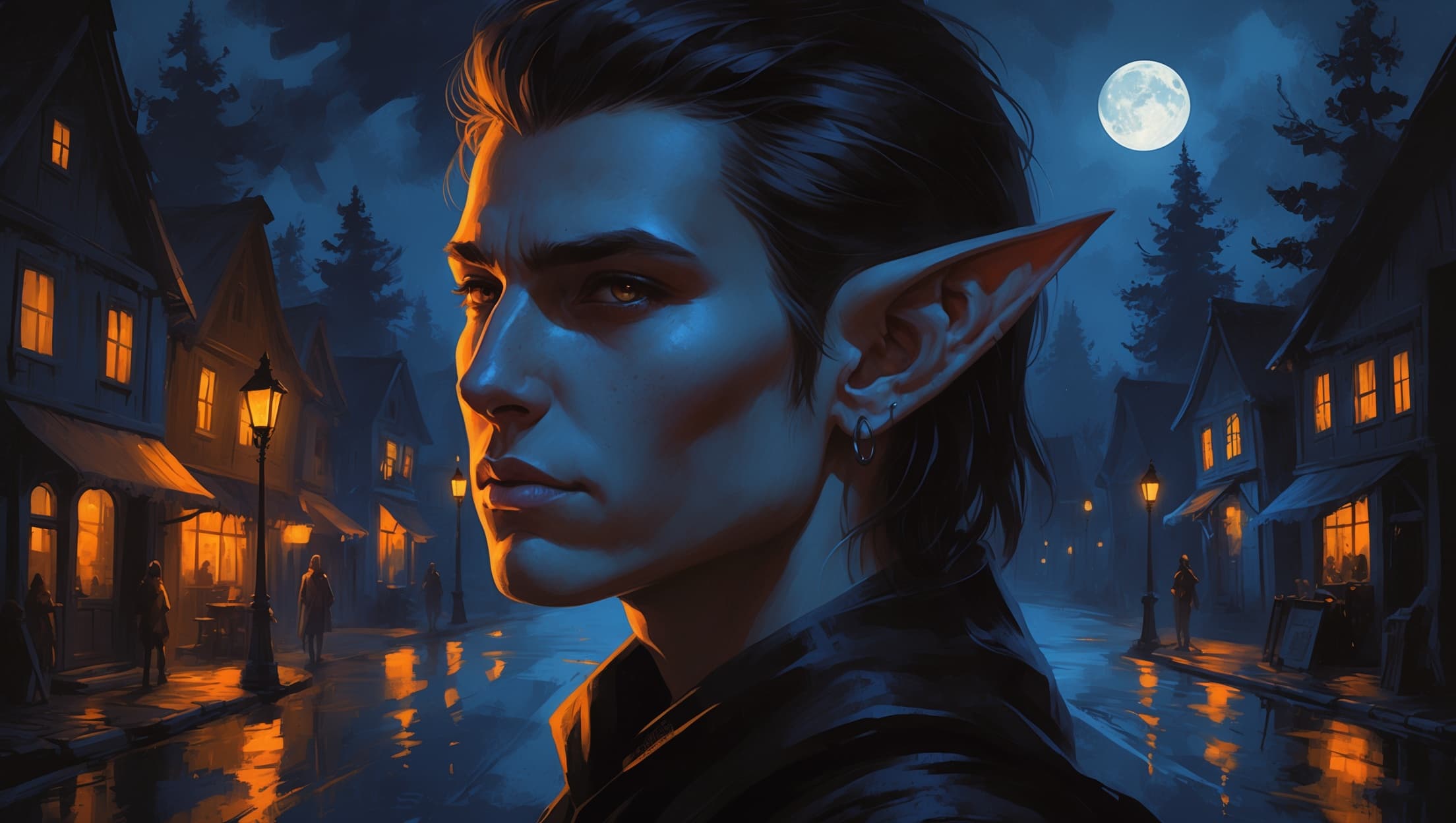
Playing a Half-Elf With an AI Game Master: The Complete Race Guide
Most D&D races ask you to commit to one identity. Half-Elves ask you to hold two at once, and that tension is exactly what makes them one of the most consistently strong picks in the game - both mechanically and at the table.
They don't have a single flashy trait like a Tiefling's horns or a Dragonborn's breath weapon. What they have instead is flexibility: a guaranteed Charisma bonus, two ability score points you place wherever your build needs them, and two skills nobody else in the party gets for free. That's a rare combination, and it's a big part of why Half-Elves have been a top-tier pick since the race first existed.
Half-Elf Racial Traits, Explained
- +2 Charisma, +1 to two other stats of your choice. A guaranteed Charisma bump plus two floating points that fit any build.
- Darkvision (60 feet). See in dim light and darkness as if it were dim light, standard for most D&D races with any elven blood.
- Fey Ancestry. Advantage on saving throws against being charmed, and magic can't put you to sleep.
- Skill Versatility. Proficiency in two skills of your choice - not a fixed list, whatever fits your character.
- Extra Language. One additional language beyond Common and your choice from your background.
None of these traits are individually dramatic. Together, they add up to a race with no real weaknesses and a build-anything ceiling that few other options can match.
Why Half-Elves Are Built for AI Campaigns
Two free skills means the AI never runs out of things for you to do
A human GM juggling a full table sometimes forgets which skills your character actually has. An AI Game Master doesn't. Whichever two skills you picked - Persuasion and Insight for a diplomat, Stealth and Perception for a scout, Arcana and Investigation for a scholar - StoryRoll's narrator keeps them in view and writes scenes that actually let you use them.
That matters more for Half-Elves than most races, because Skill Versatility is genuinely open-ended. There's no "Half-Elf skill list" to work from. The AI adapts to whatever combination you chose instead of defaulting to a generic template.
Fey Ancestry is a quiet safety net in solo and small-party play
Charm effects and magical sleep are two of the more common ways a session goes sideways - an enchanter NPC talks you into a bad decision, or a sleep spell takes you out of a fight before it starts. Fey Ancestry doesn't make you immune to everything, but it closes off two specific failure modes that hit hardest when you don't have a full party to cover for you. Playing solo or in a small party is exactly where that kind of resilience earns its keep.
The flexible ability scores let you build for the story you want
Two floating +1s sound like a small thing until you're actually building a character. They mean you're never fighting your race to make a concept work. Want a Half-Elf Fighter who leads through Charisma instead of pure Strength? Bump Strength and Charisma. Want a Half-Elf Wizard with unusually strong social skills? Bump Intelligence and Charisma. The AI doesn't have to work around a race that fights your build - it works with whatever you point it at.
If you're not sure where to put your floating +1s, default to Constitution plus your class's main stat. It's the least glamorous choice and the one that keeps you alive long enough for the more interesting choices to matter.
Best Classes for Half-Elves
Bard - The Textbook Pairing
This is the pairing everyone reaches for first, and it earns the reputation. Bard's Charisma-based spellcasting stacks directly on the Half-Elf's +2 Charisma, and Skill Versatility means you walk in with more usable skills than almost any other race-class combination in the game.
The AI GM rewards this build specifically. A Half-Elf Bard with Persuasion, Deception, and a couple of well-chosen background skills can talk their way through entire scenes that a less socially built character would have to fight through. StoryRoll's narrator tracks NPC attitudes over time, so a Bard's social wins in session two can still be paying off in session ten.
Paladin - Charisma With a Weapon
Paladins already lean on Charisma for their auras and spellcasting, and the Half-Elf's guaranteed +2 removes the usual tension between "good at Charisma stuff" and "good in melee." Put your floating +1s into Strength and Constitution, and you've got a front-line character who's also the party's best talker - without spreading your stats too thin to do either well.
The dual-heritage backstory pairs naturally with a Paladin's oath, too. An oath sworn to protect both the human town that raised you and the elven family you rarely see gives the AI two communities to build tension and stakes around instead of one.
Warlock - Patron Politics
A Half-Elf Warlock gets the same Charisma synergy as Bard and Paladin, but with a patron in the mix, the dual-heritage angle gets more interesting. Maybe your patron takes a specific interest in you because of what you are - neither fully human nor fully elf, a loophole in whatever cosmic rules usually apply. StoryRoll's AI weaves that kind of detail into patron interactions instead of treating your race as flavor text.
Sorcerer, Fighter, or Anything Else - Half-Elf Doesn't Punish You
Because the ability score bonuses are so flexible, Half-Elf works fine outside Charisma-forward classes too. A Half-Elf Fighter, Ranger, or Rogue loses nothing by choosing the race - you just place your floating +1s into your primary stats instead of Charisma and keep the free skills and Fey Ancestry regardless. It's a genuinely low-risk pick for a first character.
Quick Build: Half-Elf Bard (College of Lore)
- Ability Scores: Charisma 16 (+2 racial), Dexterity 14 (+1 racial), Constitution 14 (+1 racial)
- Skills: Persuasion, Insight (Skill Versatility) plus class and background skills
- Cantrips: Vicious Mockery, Minor Illusion
- Key Feature: Cutting Words to undercut enemy rolls in social and combat scenes alike
- Playstyle: The party's voice first, its backup plan second
Roleplaying a Half-Elf With an AI GM
Decide which heritage you lean into - or refuse to choose
Half-Elves grow up neither fully accepted by human society nor fully accepted by elven society, and how a specific character responds to that is where the roleplay actually lives. Some lean hard into their human side and barely mention the elf half. Some do the opposite. Some spend the whole campaign refusing to pick, which is its own story.
Tell StoryRoll's AI GM which way your character leans, and it builds NPC reactions and plot hooks around that choice - a human relative who never mentions your ears, an elven enclave that's polite but keeps you at arm's length, or the rare NPC who treats your dual heritage as an asset instead of a complication.
Give the AI both families, not one
The single most useful thing you can hand the AI when creating a Half-Elf is specifics on both sides of your family - who raised you, who didn't, and why. A Half-Elf raised entirely by their human mother with an absent elven father gets a different campaign than one who grew up moving between both communities. Character backstory is where this pays off: the more concrete detail you give the AI up front, the more it has to build encounters, NPCs, and plot threads from later.
Let Skill Versatility define your character's role, not just their sheet
Because your two skills aren't tied to a fixed racial list, they're one of the strongest signals you can give the AI about who your character actually is. Persuasion and Deception says con artist. Survival and Perception says someone who grew up outside both communities, in the wild between them. Medicine and Insight says a healer who reads people as well as wounds. The AI picks up on this and shapes NPC interactions and scene descriptions to match.
Half-Elves don't come with a built-in conflict the way a Tiefling's appearance does, and that's not a weakness - it just means the interesting story is a choice you make instead of one the race hands you. Decide what your character's dual heritage actually means to them, and the AI will meet you there.
Campaign Ideas Across Game Modes
D&D 5e - Belonging to Neither World Fully
The default read: a character who's spent their life a half-step outside both the human town and the elven enclave nearby. Not rejected exactly - just never quite home. The AI can build a slow arc where your character finally finds (or builds) a place they belong, whether that's the adventuring party itself or somewhere new entirely.
Campaign hooks:
- A message from an elven relative you've never met, asking for help you're not sure you owe them
- Caught between a human town and an elven settlement on the edge of a conflict neither side will fully explain
- Searching for the parent who left, and the reason they never came back
Sci-Fi - Between Two Cultures, Not Two Species
In StoryRoll's Sci-Fi mode, the same dual-heritage concept maps onto a crew member raised across two very different colony cultures, or born to parents from stations with almost nothing in common. Same social dynamic - never fully one thing or the other - different setting.
Fairy Tale - The Child of Two Kingdoms
Fairy Tale mode turns dual heritage into storybook logic directly: a hero born to a human parent and something older from the woods, welcome at the edges of both the village and the forest court but claimed fully by neither. It's a classic fairy tale shape, and the AI's narrator leans into it naturally.
Common Mistakes (And How to Avoid Them)
Treating Half-Elf as "human with pointy ears." The flexible stats are a mechanical strength, but if you don't give the AI anything about your dual heritage, you'll get a fairly generic character back. Half a sentence about your upbringing goes a long way.
Wasting the floating ability scores on your dump stats. The two floating +1s are the Half-Elf's signature feature. Put them where your build actually needs them - usually your class's primary stat and Constitution - rather than spreading them thin for flavor.
Picking skills that duplicate your class. Skill Versatility is most valuable when it fills a gap your class doesn't already cover. A Bard already gets plenty of Charisma skills from its own list; consider using your free picks on something your class doesn't naturally reach, like Survival or Athletics.
Forgetting Fey Ancestry exists. It's passive, so it's easy to forget in the moment. When an NPC tries to charm you or a spell threatens to put you to sleep, remind the AI (or just check your character sheet) - StoryRoll applies it automatically, but knowing it's there changes how boldly you can play a social scene.
Playing the dual heritage as pure baggage. It doesn't have to be a wound. Some of the best Half-Elf characters treat their in-between status as an advantage - a bridge between two worlds instead of a person stuck between them.
Half-Elves earn their reputation as D&D's most flexible race: a guaranteed Charisma bonus, two ability scores that go wherever your build needs them, two free skills, and Fey Ancestry as a quiet safety net. There's no wrong class to pair them with, which makes them one of the easiest strong picks for a first character or a twentieth.
The dual-heritage backstory is where the real payoff lives, though, and it only pays off if you hand the AI something to work with. Tell StoryRoll which side of your heritage you lean toward, or that you refuse to choose at all, and the Game Master builds NPCs, factions, and plot threads around that tension for as long as the campaign runs.
Create your Half-Elf character on StoryRoll and find out which world actually feels like home.
Try These Free Tools
Build your Half-Elf character with these free resources:
- Ability Score Calculator: plan where your two floating +1s go alongside your guaranteed Charisma bonus.
- Backstory Generator: generate a dual-heritage backstory with hooks on both the human and elven sides.
- Spell List Filter: playing a Half-Elf Bard, Paladin, or Warlock? Browse your full spell list by level.
Frequently Asked Questions
What is the best class for a Half-Elf in D&D 5e?
Bard is the classic pick - the Half-Elf's Charisma bonus and two free skills line up perfectly with a face-of-the-party build. Paladin, Sorcerer, and Warlock are also strong, since all four lean on Charisma and benefit from the Half-Elf's flexible ability score increases. Outside Charisma builds, the two floating +1s make Half-Elf a solid fit for almost any class.
Why are Half-Elves considered one of the most versatile races in D&D 5e?
Half-Elves get a fixed +2 Charisma, two floating +1 ability score increases you place anywhere, proficiency in two skills of your choice, Darkvision, and Fey Ancestry (advantage against being charmed, immune to magical sleep). That combination of guaranteed Charisma, flexible stats, and free skills works with nearly any class, which is why they're a perennial top pick.
How does an AI Game Master handle Half-Elf dual heritage?
StoryRoll's AI GM treats dual heritage as an active story thread, not a footnote. It can build NPC reactions that split along elf and human lines, surface tension between a Half-Elf character's two families, and let you decide which side of your heritage you lean into as the campaign goes on.
Can I play a Half-Elf in non-fantasy StoryRoll modes?
Yes. In Sci-Fi mode, a Half-Elf translates naturally into a hybrid-species crew member navigating two cultures. In Fairy Tale mode, Half-Elf heroes fit as a between-two-worlds character - part of the human village, part of something older in the woods. The dual-heritage hook carries across every setting.
Are Half-Elves good for solo AI D&D campaigns?
Very good. The free skill proficiencies and flexible ability scores make it easy to build a self-sufficient character who can talk, fight, and problem-solve without a party to lean on. Fey Ancestry's charm immunity is also a quiet safety net when you don't have allies to save you from a bad Wisdom save.
Written by StoryRoll
Founder of StoryRoll. Building AI-powered tabletop RPGs.
Related Posts
Playing an Aasimar With an AI Game Master: The Complete Race Guide
Aasimar pairs Charisma-friendly racial traits with a once-per-long-rest transformation and a built-in heal. Here's how the traits work, which subrace to pick, and how to build one with an AI Game Master.
Playing a Half-Orc With an AI Game Master: The Complete Race Guide
Half-Orcs pair +2 Strength/+1 Constitution with Relentless Endurance and Savage Attacks, two of the best survival and damage traits in D&D 5e. Here's how to build one and roleplay it with an AI Game Master.
Playing a Gnome With an AI Game Master: The Complete Race Guide
Gnomes pair a +2 Intelligence bonus with magic-resistant Gnome Cunning and a choice between fey illusion tricks and tinkerer's gadgets. Here's how to build one and roleplay it with an AI Game Master.